
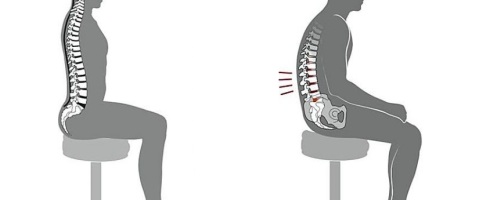
Did you know that back pain costs the economy billions of dollars a years? Low back problems account for more lost work hours than any other occupational injury.
The spine or vertebral column is make up of 33 individual bones and looks like an S-curve. This curve makes it 16 times stronger than if it were straight. The spine has a high degree of flexibility forward and to the sides, with a limited amount backward. The neck and lower back can rotate. Dense ligaments and strong muscles groups surround it and strengthen it, however the abdominal muscles may account for up to 40 percent of torso support.
Of the more than 30 million Americans who have low back pain, 80 percent probably have improper posture, weak muscles, and inadequate flexibility. Researchers call low back pain a hypokinetic disease: one that results from a lack of movement. Sedentary individuals are very susceptible to back problems.
Obesity, which a sedentary lifestyle produces, causes more weight to be carried in the abdominal muscles, resulting in greater pressure on the back. The lordosis, or swayback, is an observer’s clue to identifying someone who probably has back pain.
Maintaining proper segmental alignment of the body in all activity is of utmost importance for preventing and treating back pain. In other words, GOOD POSTURE is the key. Optimal posture puts the least amount of strain on the ligaments and joints in the spine, pelvis, and legs. Proper body posture while walking, sitting and lifting are essential in preventing and controlling low back pain.
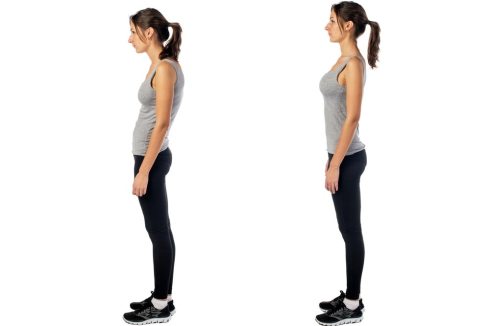
Here’s how to find a good posture balance for yourself: Stand with your pelvis titled in a neutral position. This means you pull in your abdominal muscles and slightly tighten your buttocks. This distributes your weight evenly and protects your lower back. Shoulders should be relaxed, down and back slightly. Keep your knees slightly flexed, not locked.
Here’s a quick way to correct your posture if you notice you are slumping: Place your elbows against the side of your waist with the arms bent 90 degrees and your hands in front of you. Keeping your elbows in place, rotate your hand and forearms to the sides. Your shoulder blades will move toward each other and lift your chest, correcting your posture. Then lower your forearms and maintain the improved posture! Walk with your head, trunk and thighs aligned, shoulders held back yet relaxed, chest high, and your stomach tucked in.
To help you maintain good posture when sitting, your chair should support your back with your knees lower than the hips. When lifting heavy objects, focus the lifting action in the hips, pulling with the upper hamstrings in combination with the buttocks. Contract the spinal muscles to maintain a straight back and tighten your abdominal muscles. Lift with an upward movement. Try to keep the object you are lifting close to you body. Don’t lift any object when your trunk is twisted.
Many people don’t have the body mechanics or strength to assume desirable posture, however, help is available. It’s exercise. Exercises for abdominal muscles, back strengthening and stretching, and pelvic training done gradually can correct posture and relieve back pain.
Here are a few exercises that may be used in a program to prevent or alleviate low back problems. Beginning exercisers should consult a doctor before starting any exercise program.
Pelvic Tilt: Lie with your knees bent, feet flat on the floor. Tighten your buttocks, pull in your stomach and flatten your lower back against the floor. Hold 5-20 seconds, relax, and repeat several times.
Curl-ups: Lie on your back, knees bent, feet flat on the floor. Keep your back against the floor and your abdominal muscles tightened. Lift only your shoulders and head, with your hands either across your chest or lightly behind your head. Move slowly. Do 10-25 curl-ups per set, working up to 3 sets. Avoid full sit-ups or double leg lifts which can cause more back pain.
Low Bach Stretch: Lie on you back and draw you knees toward your chest. Clasp them with your hands keeping your shoulders flat on the floor. Pull the knees closer to your chest and hold several seconds.
Low Back and Hamstring Stretch: Lie on your back, knees bent. Bring one thigh toward your chest, knee bent and hold the stretch for 15 seconds. Then straighten that leg toward the ceiling to stretch down the back of the leg. Support the leg with your hands and hold for 15-30 seconds. Bend the knee, lower the foot to the floor keeping the knee bent, and repeat with the other leg.
A posture program can have a positive effect on the health of you back and if you are sedentary it may give you the incentive to add even more fitness activities to your life.
where to buy steroids online forum











 Master Muscle Blog
Recent Comments